Two Mutually Tangent Circles in a Rectangle

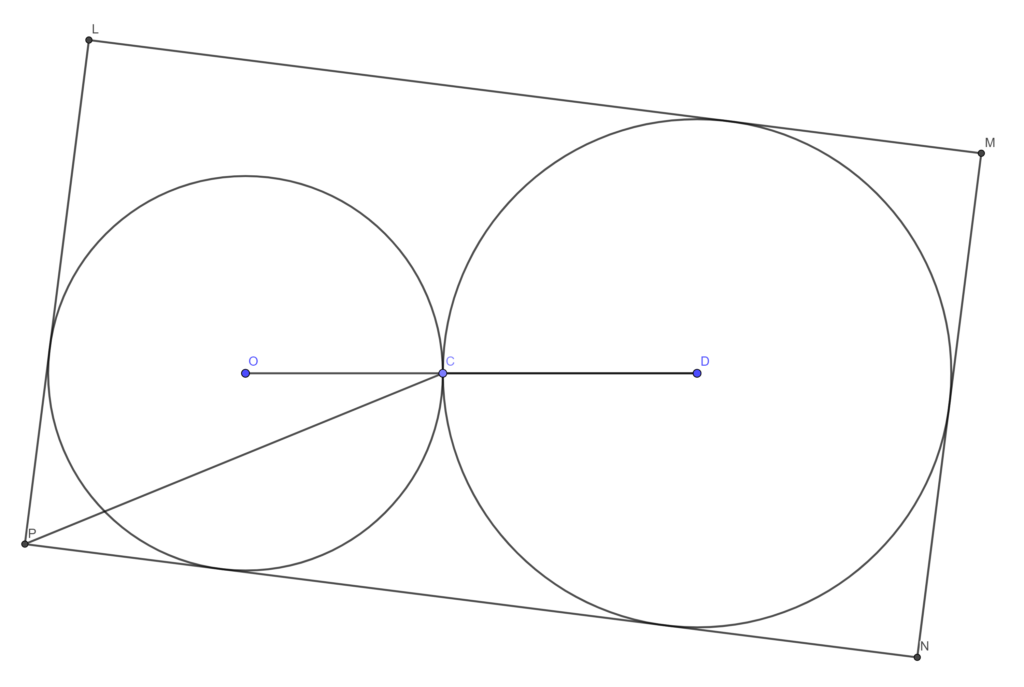
In this geometry problem two circles of different sizes and two line segments of equal length fit precisely in a rectangle. Given that the smaller circle has radius 1, what is the radius r of the larger circle? The circles are mutually tangent at point C as depicted. The unit circle on the left is tangent to two sides of the rectangle, and the larger circle of radius r is tangent to three of the sides. The line segment OD connects the centres of the circles. The rectangle has been adjusted so that the distance from the point of tangency C to the nearest corner P is equal to the length of OD. Can you develop an equation in its simplest form for the radius r? Additionally, express the width and height of the rectangle in terms of r.
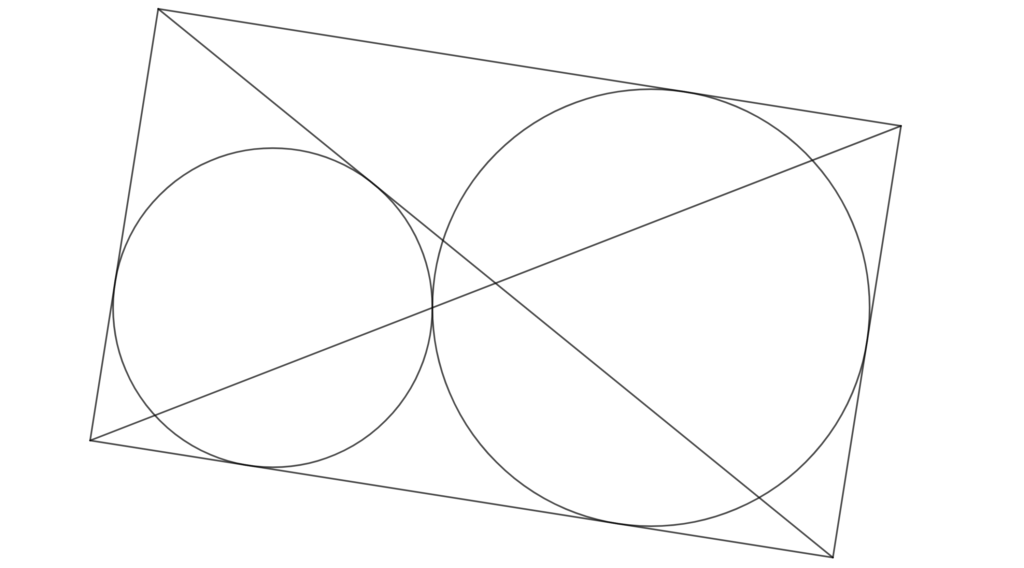
Two Discs in an Envelope

Two circles are inscribed in a rectangle as shown. One diagonal passes through the point of tangency where the two circles touch, and the other diagonal is tangent to the smaller circle.

You may define the radius of the large circle as 1 and the radius of the small circle as r. Can you find an equation for r, and numeric values for r and for the lengths of the sides of the rectangle?

I created this construction using Geogebra, iteratively adjusting it until everything fitted. The aspect ratio of the rectangle turns out to be about 1.72, a fact that can be used to check your own result. The dimensions of the rectangle are not an initial condition, but a consequence of the radii of the two circles. However, as an alternative exercise try drawing this construction yourself, beginning with a 100 by 172 rectangle.

I am delighted to report that this problem was solved independently by Ted Courant and by Keith Raskin after I posted it on the Math, Math Education, Math Culture group on LinkedIn. They also observed that the rectangle is more accurately drawn with side lengths 1003 and 1725.

Isosceles Triangle and Square of Equal Area in a Circle

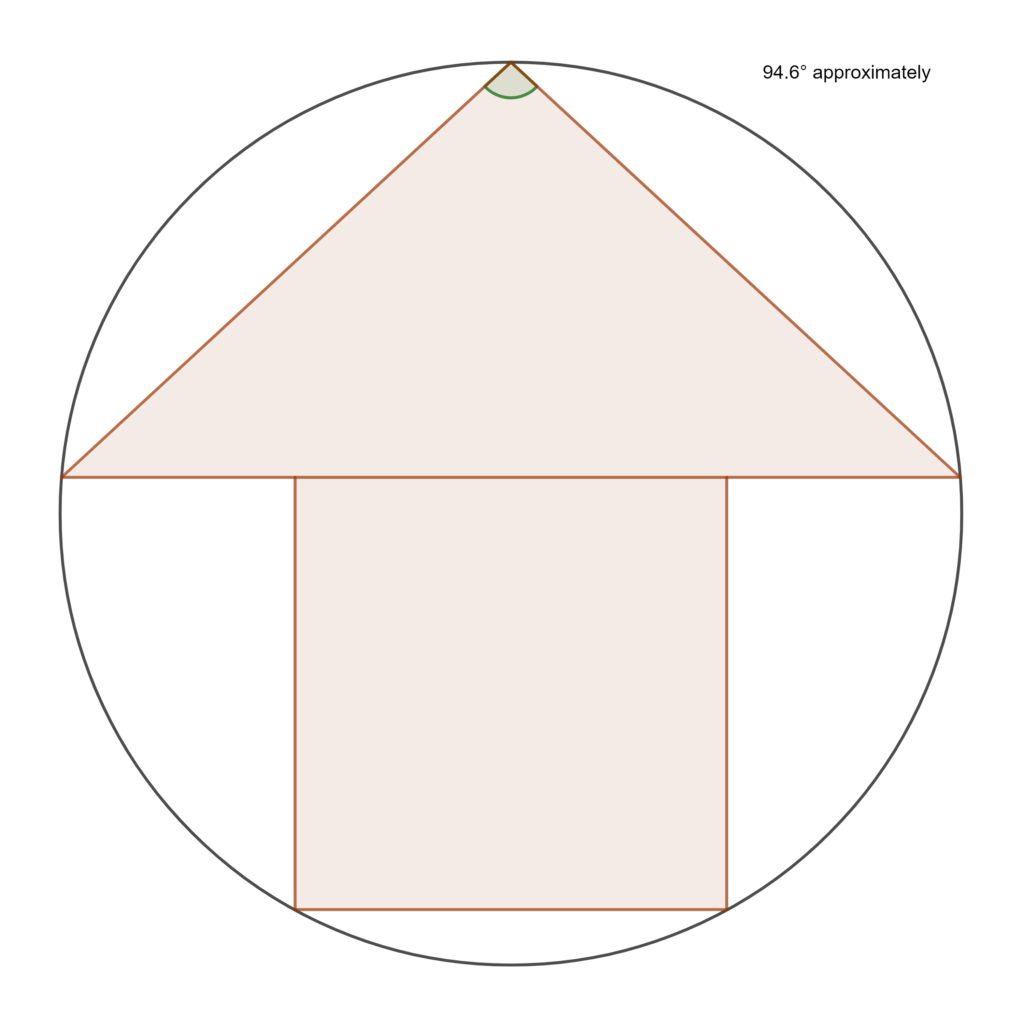
An isosceles triangle and a square with equal areas are inscribed in a circle as shown. The construction was created using Geogebra, iteratively zooming in and adjusting it until everything fitted precisely. The apex angle of the triangle measures 94.6° approximately, a fact that can be used to check your own analysis. Unable to find algebraic results, I concluded that the exercise for the reader is:

Express simultaneous equations for this construction, and use computer algebra software to find numeric values for the lengths of the edges. You may define the radius of the circle as 1. Note that the base of the triangle is slightly shorter than the diameter of the circle. The centre of the circle is unmarked, locating it being part of the exercise.

An alternative exercise is to take the apex angle as given, define the height of the triangle as 1, and create an accurate construction using trigonometry and a square root calculation.

Two Equal Rectangles in a Circle Solved

In my previous post I presented a geometry problem with two equal rectangles in a circle. https://convexabacus.xyz/index.php/2022/04/25/solve-two-equal-rectangles-in-a-circle/

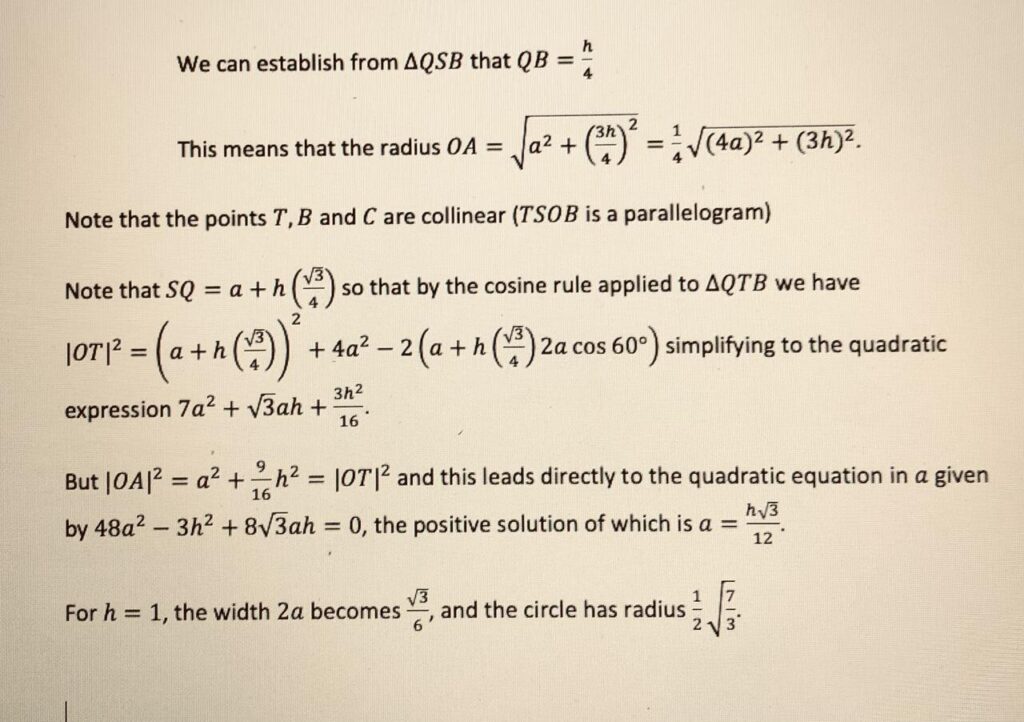
I am happy to report that it was solved by Ed Staples. His solution is shown below, applying the cosine rule on triangle OST, not QTB, which is a typo in the image. Given that the height of the rectangle is 1, he calculates that the width (2a) of the rectangle is sqrt(3)/6 and the radius of the circle is (sqrt(7/3))/2.

There is more than one way to approach this problem. It was solved independently by three members of LinkedIn when Ed posted the problem there. If you don’t know where to start, I suggest looking for 30-60-90 degree triangles in the construction.

I created this construction by exploring several variations using Geogebra and this was the only one I could find that led to a good mathematics problem. A simpler way of fitting two equal rectangles in a circle is left as an exercise for the reader.

Solve Two Equal Rectangles in a Circle

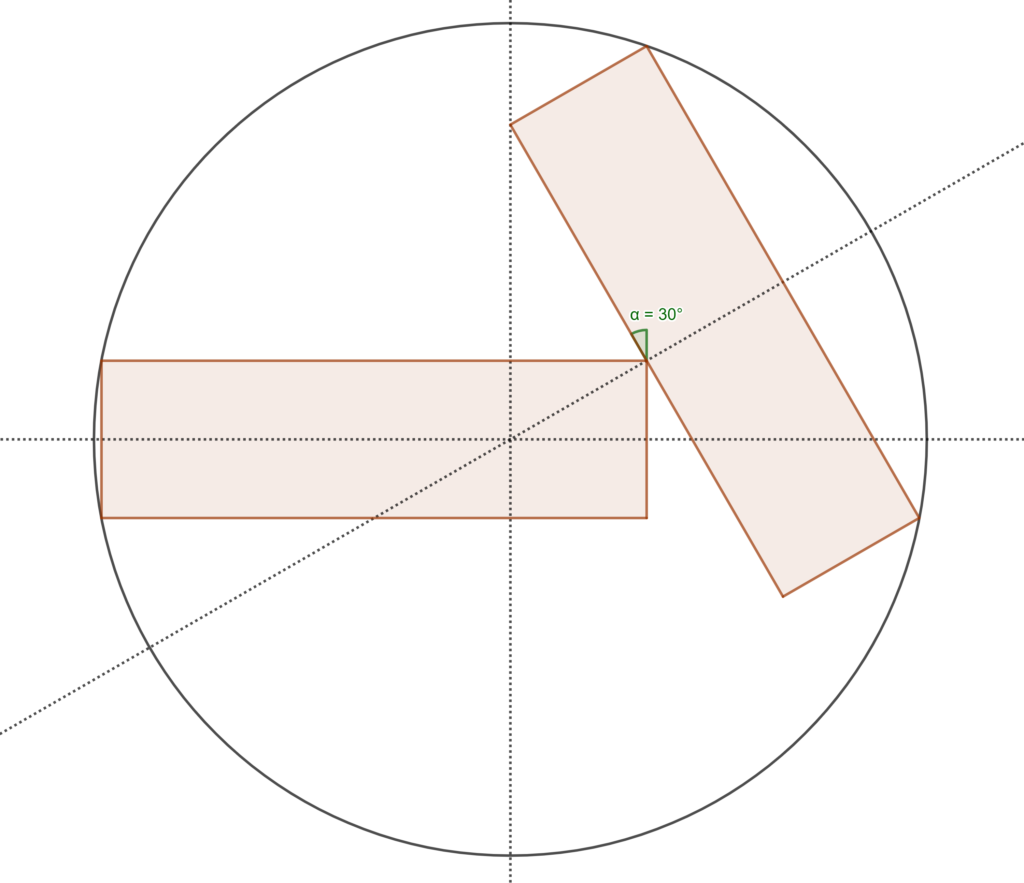
Here is a new geometry problem with two equal rectangles in a circle that you might like to try. The corner of one rectangle touches the midpoint of a side of the other. The left hand rectangle is horizontal in the diagram and the right hand rectangle is tilted 30 degrees from vertical. I created this construction using Geogebra. Ed Staples, who I collaborate with on this series of problems, made the following labelled diagram. Can you find the width 2a of the rectangles in terms of their height h, and the radius of the circle when h is 1?

Squares and Triangles in a Semicircle

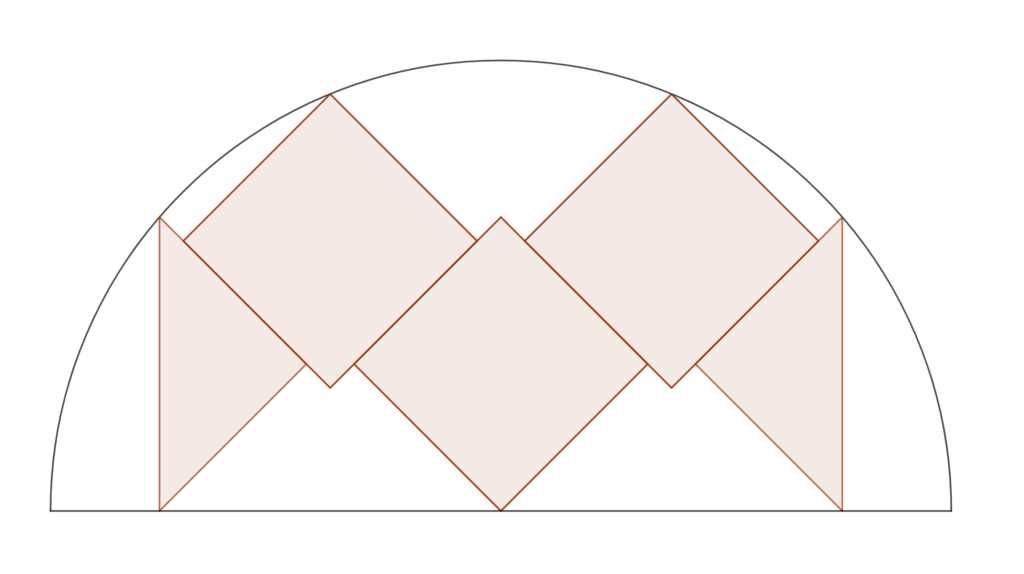
Following on from my previous puzzle with three equal squares in a semicircle https://convexabacus.xyz/index.php/2022/04/11/three-equal-squares-in-a-semicircle/, here is a more elaborate problem where the three squares are flanked on either side by two half-squares in the shape of isosceles triangles. Assume that the length of the side of the squares is 1, including the orthogonal sides of the two triangles. The four contact points of corners with the circle and the three contact points of corners with the horizontal diameter constrain the construction, defining a unique solution.

I created this diagram in Geogebra, iteratively adjusting it until the corners touch the semicircle, and repeatedly zooming in on one contact point to maximise the accuracy.

I am delighted to report that shortly after posting the diagram on LinkedIn, it was solved by Stéphane Jaubert. His solution is:

radius r = sqrt(30-8.sqrt(10)).

Numerically, this is about 2.16835853. My estimate using Geogebra was off by just -0.000001.

Two Equal Rectangles in a Semicircle

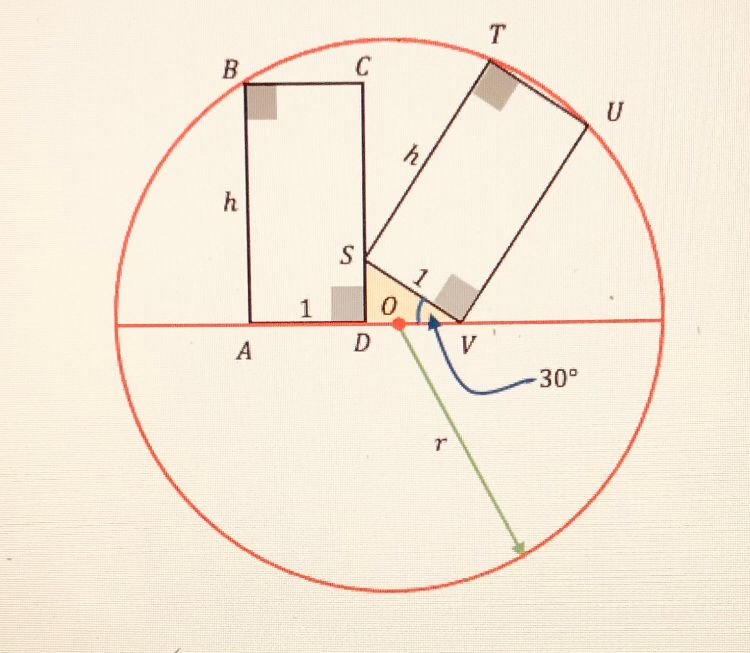
In this construction two equal rectangles are jammed into a semicircle, one sitting vertically and the other leaning over at a tilt of 30 degrees. The puzzle is described as follows: Two equal rectangles, ABCD and STUV, both have a width 1 but an unknown height h. The left rectangle sits on the diameter of a circle of radius r and has its top left vertex B touching it as shown in the diagram. The right rectangle, leaning at 30 degrees to the diameter, touches the circle at T and U, has its bottom left vertex S touching the left rectangle, and its bottom right vertex V touching the diameter shown. Can you calculate exact expressions for the height h of the rectangles and the radius r of the circle? I thank Ed Staples for this concise statement of my problem, for his diagram shown below, and for his solution which will be shared later. ( Permit a little history. In my first draft the rectangles were of fixed dimension 2 x 1 and the tilt angle was unknown. Unable to solve this, I fixed the tilt angle at 30 degrees and made the height unknown – resulting in nicer problem. )

Solution of Two Unit Squares in a Semicircle

As usual, my online colleague Ed Staples has provided a succinct solution to this problem. I attach his diagram and result below. You can see that he began by bisecting the chord AB and drawing the perpendicular bisector MC. He calculated the radius of the circle as an exact expression involving square roots, which has an approximate numeric value of 1.5213. This is in agreement with the value I found experimentally when using Geogebra to create the problem. The problem statement is here: https://convexabacus.xyz/index.php/2022/04/11/two-unit-squares-in-a-semicircle/

The problem was shared on LinkedIn where it was solved by Mohamad Saleh. He took a different approach using coordinate geometry and simultaneous equations. I attach his work below in two images.

Diagram (above) and solution (below) by Mohamad Saleh.

Two Unit Squares in a Semicircle

Two unit squares are jammed inside a semicircle. The left square, whose base lies on the diameter, has a single vertex touching the circle. The right square, tilted 45 degrees such that one diagonal is perpendicular with the diameter has a vertex touching the diameter, a vertex touching the left square and two vertices touching the circle. Can you find an exact expression for the radius of the circle ?

Two unit squares in a semicircle, one tilted 45 degrees

Three Equal Squares in a Semicircle

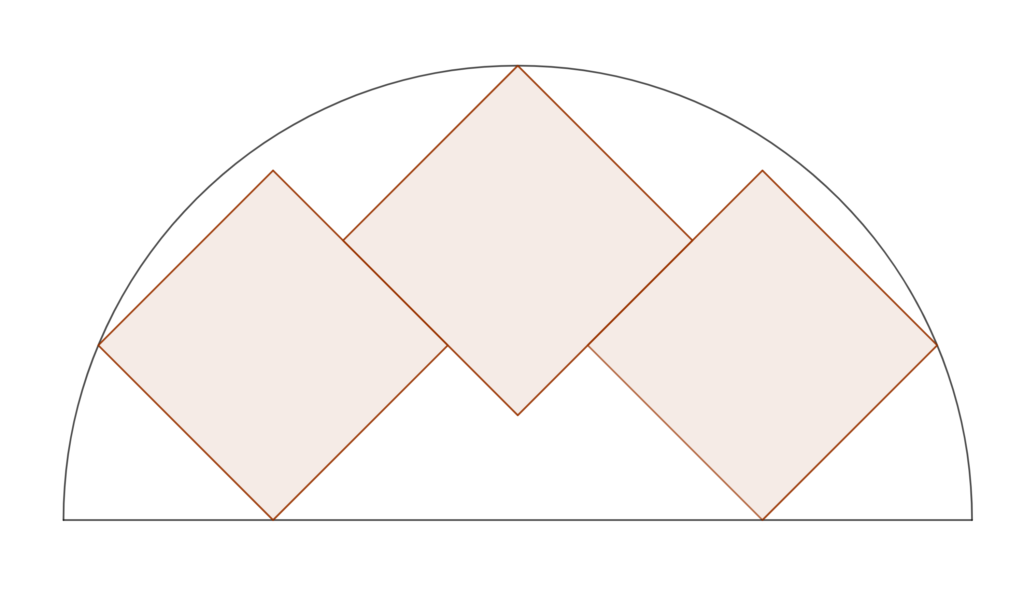
In this construction three unit squares are butted up together inside a semicircle. Each square has a vertex that touches the circumference, and the vertices of two of the squares lie on the diameter shown. The vertical diagonal of the middle square is in line with the circle’s centre, so everything looks quite symmetrical. Can you find the exact value of the radius of the circle? I constructed this arrangement experimentally using Geogebra. I thank Ed Staples for this concise statement of the problem.

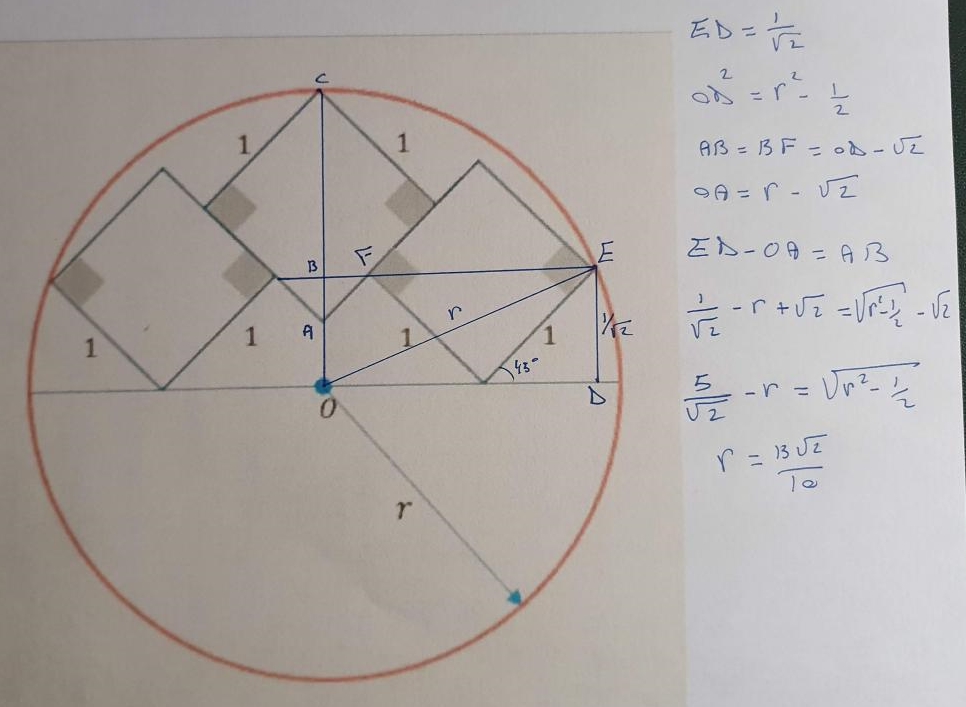
This problem was shared on LinkedIn, where it was solved by Stéphane Jaubert who calculated the radius as r=13.sqrt(2)/10. His work is attached below.

Problem solution